
Even Onesies Need Explaining
When I hit my second trimester of pregnancy, I finally started to feel human again and even excited to reenter society. As my baby bump began to emerge, my husband and I started to enjoy wandering through baby stores and oo-ing at the miniature versions of everything. I was especially smitten by the tiny socks.
But it was under the fluorescent lights of Carter’s that I first realized even onesies are no longer straightforward.
Because we were building our baby’s wardrobe from scratch, we had decided to stick primarily to purchasing natural fibers. If we were going to spend our own money, we wanted to vote with it. 100% cotton it was.
Apparently, I had forgotten that it was 2025: the era of overcomplicated labels, a million different certifications and endless claims that do not necessarily mean what one assumes they mean.
We stood there for an embarrassingly long time, turning over tag after tag trying to determine whether “100% cotton,” “OEKO-TEX certified” and “GOTS-certified organic cotton” were three different ways of saying the same thing.
They are not.
One tells you what fiber the onesie is made from. Another tells you that the finished garment was tested for certain harmful substances. The last tells you much more about how the cotton was grown and how the fabric was processed before it became the outfit your baby will immediately spit up on.
So, I’m breaking it all down here to save you from conducting your own textile investigation in the middle of Carter’s.
What Cotton Labels Say & What They Don’t
I’ll start off by stating that much like food industry, when it comes to textiles, a certification-free item is not automatically bad, and a certified item is not automatically perfect. Small brands may use excellent materials without paying for certification, while large brands can lean heavily on one legitimate certification and let consumers assume it means more than it does.
Here are the cotton-related labels you might run into, in order from (seemingly) simple to my eyes are glazing over:
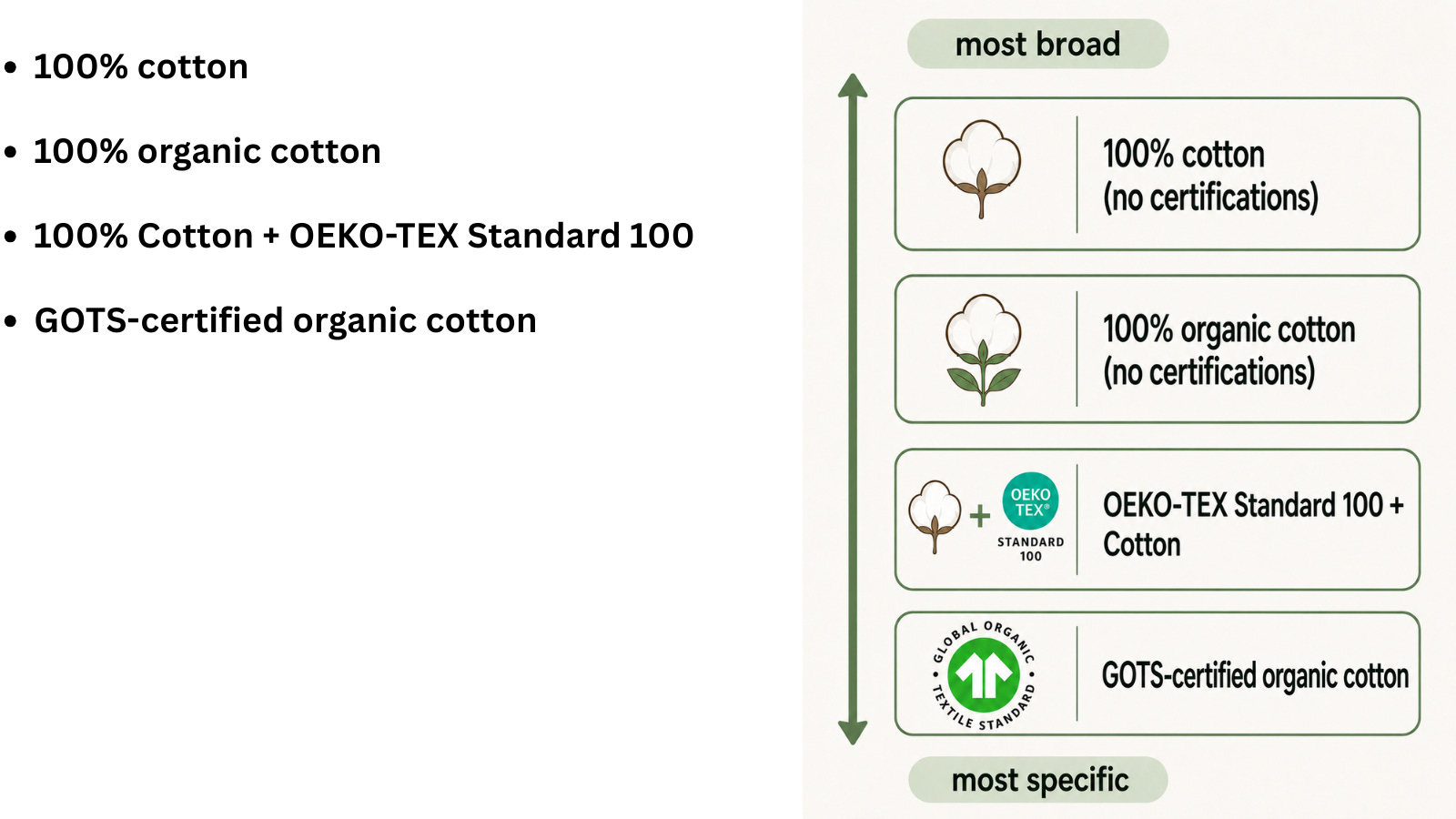
Let’s break it down:
100% cotton
This tells you the garment’s fiber content: it is made from cotton rather than polyester, nylon or another textile fiber1. That’s the extent of the information.
“100% cotton” does not tell you how the cotton was grown, what dyes were used or which treatments and finishes were applied during manufacturing. You have identified the main ingredient, not the recipe.
100% organic cotton
This tells you that the cotton fiber was organically grown rather than conventionally grown2. But again, unless the finished textile carries an additional certification, you cannot know what happened after the cotton was harvested. The fabric may still have been treated in some mysterious way.
Organic cotton is ideal, but the cotton does not float directly from the field into a tiny pair of ribbed pants.
Cotton + OEKO-TEX Standard 100
This means the garment is made from cotton and has been certified to OEKO-TEX Standard 100. What is that? It’s a certification that tests the final textile and its components against limits for a long list of potentially harmful substances3.
It does not mean the product is made from cotton or organic cotton, those must be indicated separately. OEKO-TEX Standard 100 is answering, “What might be present in the finished onesie?” rather than, “How was the cotton grown?”
For baby clothing, OEKO-TEX gives products intended for babies and children up to age three the strictest requirements and limit values.
Sometimes a garment will say both organic cotton and OEKO-TEX Standard 100. That simply combines two claims: one about how the cotton was grown and one about testing of the finished textile.
GOTS-certified organic cotton
This is the most comprehensive label in this group. It starts with certified organic fiber and extends into textile processing, including requirements involving chemical inputs, environmental practices, traceability, independent third-party certification and human-rights and social criteria throughout the textile supply chain4,5.
It tells you considerably more than “this started as organic cotton.” GOTS follows the fiber through much more of its journey from raw material to finished clothing.
There is one important wording distinction to watch for here. A product carrying the GOTS “organic” label must contain at least 95% certified organic fibers. A product labeled GOTS “made with organic materials” may contain as little as 70% certified organic fibers.
Where I’ve Landed
Although we love seeing our baby’s adorable mini bum, he spends most of the day (and all night) in clothing. He sleeps in it, sweats in it, plays in it and regularly tries to eat the sleeves. So the materials touching his skin matter to me.
In a perfect world, I would probably dress him exclusively in GOTS-certified organic cotton. In the real world, we are balling on a budget—and we also enjoy putting him in cute clothes. So we pick and choose.
Baby and children’s clothing is not talked about nearly enough. What we put in our bodies has become a widely accepted topic of conversation, but what we put on our bodies is still fairly niche.
Clothing goes through many stages between the field and the finished onesie, including bleaching, dyeing, printing and softening. Because of that, I give the most thought to the clothing worn most often and closest to the skin. We scrutinize labels and certifications more carefully when shopping for pajamas and base layers, and less so for a jacket worn over several layers or a special-occasion outfit worn for one afternoon.
I do not think this needs to become another category of parenting in which anything short of perfection feels like failure.
The goal is not to build a flawless closet. It is to understand what the labels mean, decide what matters most to your family and spend your money accordingly.
A Simple Shopping Cheat Sheet
If you are standing in a store staring at a row of tiny tags, here is the easiest way to think about it:
You want to avoid synthetic fibers:
Look for 100% cotton. This tells you what the garment is made from, but not how the cotton was grown or how the fabric was processed.
You want cotton that was organically grown:
Look for 100% organic cotton and, ideally, information about how that claim was certified. This tells you more about the fiber’s agricultural origin, but not necessarily every step that came afterward.
You want the finished garment tested against limits for certain harmful substances:
Look for OEKO-TEX Standard 100. This certification is about testing the finished textile and its components. It does not automatically mean the cotton is organic.
You want certified organic fiber plus broader processing standards:
Look for GOTS, and read the exact wording on the label. GOTS covers much more of the textile supply chain, but its “organic” and “made with organic materials” grades require different percentages of certified organic fiber.
You find several of these claims on one garment:
Great. Labels can stack. A garment can be organic cotton and also certified to OEKO-TEX Standard 100. Each claim is simply telling you something different.
And if all you can find—or all you can reasonably afford—is a basic 100% cotton onesie, that is still useful information and may still align perfectly well with your priorities.
I still read the tags and always will. I just no longer stand in Carter’s staring at them as though one contains a secret message intended only for textile scientists.
Sources Cited:
1: Federal Trade Commission: Calling It Cotton
2: USDA Agricultural Marketing Service: Organic Textiles
0 comments